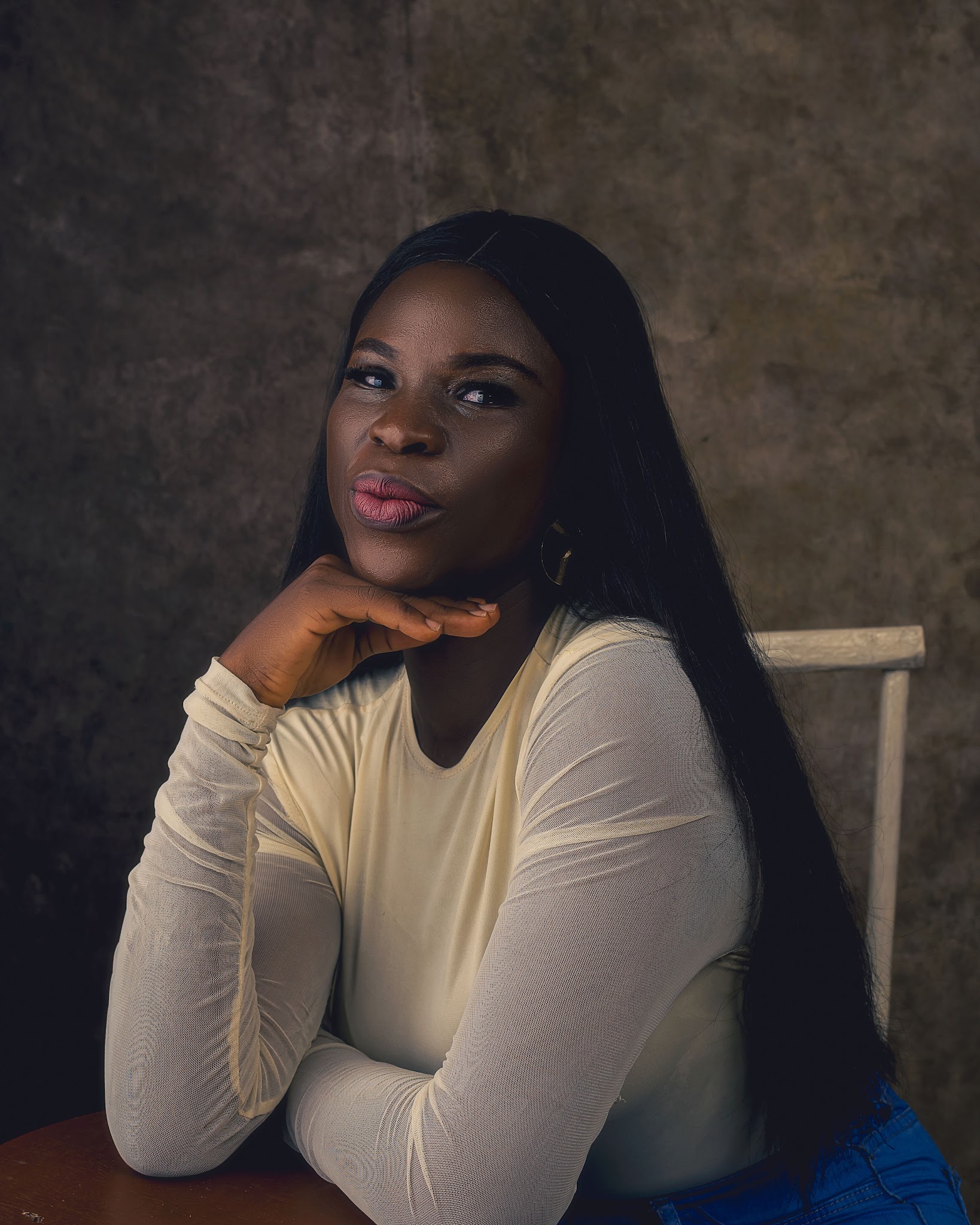
A Conversation with Ejiro Edward
by Juliana Nwazodoni
What led you to start writing, and what did those early beginnings look like for you?
Response:
I believe what led me to start writing is my desire to make my readers see themselves in my pieces. I wanted to express what others can’t identify on their own. First, it started as my desire to explain myself on paper, because words couldn’t express it, and ever since then, my writing has been more vocal, especially regarding social justice.
The early process was a lot of failure and uncertainty. It involved a lot of reading, and it still does, but now I am better informed about what I want to see in my writing. So I strategically look at works that inform my own writing, and I am not just talking about novels; I’m talking more about articles, books, and history.
The beginning felt more like a collective journey cause I was doing this alongside my friends. Now, it feels more like a pilgrimage of discovery, redefining myself as an artist and being more definitive of what I desire in my pieces.
Which writers or works influenced you in your formative years, and how did they shape your voice?
Response:
The books that shaped my early writing, rather than what millennial Nigerian artists would say, like Chimamanda Adichie, whom I would love to claim as my role model. Unfortunately, the authors who shaped my process as a teenager were more like Dan Brown, Warsan Shire, and Francine Rivers. I also was deeply obsessed by the author who wrote the Concubine, which is Elechi Amadi. I think I was deeply obsessed by the character Ihuoma. I believe what makes a great book memorable is when the author has the ability to create characters that the readers can be obsessed with.
Later on, other authors I gradually came to look to are Sefi Atta, Chimamanda Adichie, Romeo Oriogun, Ayobami Adebayo, Chigozie Obioma, and Khaleed Hosseni. This set of people really helped me realize that there are countless stories that need to be told, and that they take different approaches to telling them.
In practical terms, how did you approach writing at the beginning? Were you sharing your work, submitting to platforms, or mostly keeping it to yourself?
Response:
In the early stages of my writing, I was submitting without caring about the editing process. I took the professional route and sent it to magazines rather than sharing it on social media. I was eager to get published, and when I look back at those works, I feel embarrassed by the quality of the work I thought was worth publication. A good artist should be able to look back at their work and see how they evolve through the process. I am currently working on a collection, and as much as I enjoy it, I am committing my time to making every word in it count. I seek constructive feedback that improves my work.
Here’s the thing: at the very beginning, I believed I was the very best thing next to ice cream. But when you read widely and dive into the world of other artists, seeing the dedication of individuals to their craft and the effort they put into their work, you are slapped with the reality of how much more work needs to be done.
Did your immediate environment influence your writing in any way, and how did that show up in your work?
Response:
Honestly, I grew up in the most ghetto of all places that one could grow up in Nigeria. I lived in Ajegunle, and somehow, I was protected from it. I love telling people I grew up in Ajegunle, cause it doesn’t fit the perception they have of me. However, my environment did not really shape me as a writer. However, my experiences as a female and as someone who grew up in Nigeria it has definitely shown up in my writing. One can’t live in a country like Nigeria and ignore what’s happening. My duty as an artist is to re-echo the distress of the world that we live in. My current collection reflects my place as a woman in the world. The next collection will reflect on myself as a Nigerian and a black individual, and on the nuances of migration driven by the distress in my country.
Before the publications and awards, what was the one thing that kept you committed to writing?
Response:
What kept me committed was seeing all my friends use this to create a pathway for themselves. It was also a desire to see my craft read by the world because I deeply believe that I have something tangible to say. In a world that constantly gives a platform to the wrong people, my friends and I have something tangible to offer. In the words of Schumann, to send light into the darkness of men’s hearts is the duty of the artist.” That is what has committed me to the craft.
What would you say to budding writers who are trying to build their craft with little or no support?
Response:
Read! One can never exhaust reading. Read outside your country. Read other writers from other parts of the world. Revise your work. A work is never truly complete, even when it has been published. But always give the best to each work. Think about it as the representation of you. What do you want people to experience when they have their first encounter with you? Be ready to receive constructive criticism. One should be open to feedback and not be stuck in one mentality. Also, go to workshops. Always insert yourself in places that will inspire your work process.
What structural changes do you think the Nigerian creative industry needs in order to better support emerging writers?
Response:
There is a need to have a mentorship program in place that ensures that artists within Nigeria are not losing their spark. A kind of system that allows for the mentor to check the progress of their mentee. This is something that I desired when I was younger and I am grateful for the new friendships that I have, that ensures that I am getting better in my craft. The likes of Sofiul Azam, Romeo Oriogun (long term mentor) and Praise Osaworu implore me to desire more.
Also writing programs is something that should be more consistent in the appearance of Nigerian spaces. The Rongo Art Foundation, an organization that is an initiative of the Benin Art and Book Festival which I am a co-founding member of, is working towards creating lasting systems that will push for the growth of emerging writers. Stating this here, so that the writers within Nigeria can keep an eye out for this opportunity.
Ejiro Elizabeth Edward is a passionate lover of the arts. She has won several awards across poetry, fiction, and non-fiction conventions. She has also been published in magazines such as Room, Reckoning, Lolwe, and Feral, amongst many others. She was recently awarded the Obsidian Fellowship, the Slough House Residency, and the Chateau Orquaveux residency. She is currently pursuing her master’s degree in creative writing and environment at Iowa State University, where she also serves as a graduate assistant. She is also the co-founder of Benin Arts and Book Festival.
She loves to dance, read, and travel when she’s not trying to balance her life as a student.